Phonological Awareness
Hearing and playing with the sounds inside spoken words.
Hearing and playing with the sounds inside spoken words.
You do not need to be a teacher, buy anything, or set aside a lesson time. Everything below fits into the parts of the day you already have.
Phonological awareness is an ear skill, not a reading skill — none of it needs paper or screens. Clap the beats in your child's name. Sing songs that rhyme and pause before the rhyming word so they can fill it in. Say a compound word in two pieces — cup … cake — and let them push it back together.
Two or three minutes at a time is plenty. Children this age learn sound play in tiny bursts, repeated often, far better than in one long sitting.
Rhyming and clapping syllables come first. Sounding out individual letters comes much later. If your child is still working on rhyme, keep rhyming — there is no rush to move on.
By the end of pre-K, most children can tell you whether two words rhyme, clap the syllables in a familiar word, and hear the first sound in a word. If those are hard, share what you're noticing with your child's teacher.
Detailed definitions for both terms are below:
Phonological awareness is the ability to recognize and manipulate the spoken parts of sentences and words. Examples include being able to identify words that rhyme, recognizing alliteration, segmenting a sentence into words, identifying the syllables in a word, and blending and segmenting onset-rimes. The most sophisticated — and last to develop — is called phonemic awareness.
Phonemic awareness (also called phoneme awareness) is an advanced subskill of phonological awareness. Both phonological awareness and phonemic awareness are auditory skills that are often called "in the dark" skills, meaning they could even be practiced in the dark and you practice both without the use of any letters.
Research outlines the importance of employing Structured Literacy Principles to teach phonemic awareness in a systematic, structured, cumulative, explicit and diagnostic fashion.
Research is clear that emergent literacy is taught best when instruction follows the four Structured Literacy Principles. Here is what each one looks like for phonological awareness.
Instruction follows a logical order, begins with the easiest concepts, and progresses to more difficult concepts (EX: A teacher's scope and sequence for teaching phonological awareness starts by teaching easier skills (alliteration, rhyme, compound word blending) and progresses to harder skills (onset/rime blending, phoneme blending)
Each step must be based on concepts previously learned and continual review until mastery must be a part of practice. Systematic, sequential and cumulative learning enhance explicit instruction (EX: "Remember last week when we were taking two separate words and blending them together to make a compound word? This week we will do something similar, but we will use short chunks of words rather than full words. I can show you with names. For instance, I will say one of your classmate's names in two short parts, or syllables. You blend them to tell me whose name I say: 'Ta' – 'jaun'." Even if a student demonstrates mastery of a particular skill such as rhyme one day, a teacher may continue practicing rhyme for a while prior to transitioning to something like alliteration. Additionally, some of these skills have a scope and sequence of their own, within the overall scope and sequence of phonological awareness. For instance, a student may be able to identify which target words rhyme or even judge if a set of two words rhyme, but they may not be able to eliminate a word that doesn't rhyme with the other two from a series of three words or produce rhyming words for a target word).
Teachers use approaches such as gradual release of responsibility models (I Do, We Do, You Do) where the teacher models and students have multiple opportunities to practice with support and independently (EX: A teacher may model tapping out each syllable in a verbally stated word. Then, students will get an opportunity to practice as a class tapping out the syllables in words the teacher says, with the teacher guiding and providing corrective feedback as needed. Finally, students may work independently to place out a penny or chip for each syllable they hear in a word the teacher says aloud).
Teachers use a phonological awareness assessment to gauge their students' skills and decide where to start phonological awareness instruction. Teachers also regularly progress monitor phonological awareness skills so they can know when to introduce a new concept (use CLSD project created assessment/CBM such as rhyme awareness, beginning sound knowledge OR use a free assessment such as PAST, modifying it if necessary based on student age/ability).
Findings below are drawn from What Works Clearinghouse educator practice guides published by the Institute of Education Sciences, U.S. Department of Education.
The Works Clearinghouse (2022) report, "Preparing young children for school: Educator's practice guide," (pg. 54-61) indicates strong evidence for intentionally planning activities to build children's vocabulary and language; building children's knowledge of letters and sounds; using shared book reading to develop children's language, knowledge of print features, and knowledge of the world. From these three recommendations, building children's knowledge of sounds is the most relevant to phonological awareness. The WWC report recommends a range of sound focused activities to target listening for sounds in words (beginning sound, rime pattern) or using songs and poems that highlight sounds. https://ies.ed.gov/ncee/WWC/Docs/PracticeGuide/TO4_PRACTICE_GUIDE_Preparing-for-School_07222022_v6.pdf
The What Works Clearinghouse (2016) report, "Foundational skills to support reading for understanding in kindergarten through 3rd grade: Educator's practice guide," (pg. 14-21) indicates strong evidence" for developing awareness of the segments of sound in speech (phonological/phonemic awareness) and how they link to letters (phonics). Specific strategies for phonological/phonemic awareness were identified such as isolating, segmenting, blending, and manipulating first larger chunks (words in sentences, component parts of compound words, syllables in words) and then smaller units of sound (onsets/rimes, phonemes). For instance, teachers can start by dictating a sentence and having students listen and count the number of words in a sentence and then move identifying rhyming words, identifying alliteration, blending/segmenting/manipulating compound words, blending/segmenting/manipulating multisyllable words, blending/segmenting/manipulating onsets/rimes, and blending/segmenting/manipulating phonemes. Using visuals or manipulatives to represent sounds can be particularly helpful. For instance, a teacher/student hold up the left fist to say the first part of a compound word ("wheel"), the right fist to say the second part of a compound word (chair), and then blend the two words together while bumping their right and left fist together to say the full compound word (wheelchair). Or, a teacher could use Elkonin boxes to represent each phoneme in a word and students must touch each box with their finger as they segment each sound in the word. https://ies.ed.gov/ncee/WWC/Docs/PracticeGuide/wwc_foundationalreading_040717.pdf
The progression of skills from most basic to most difficult is as follows:
Each skill is outlined below, with sample activities to target each skill. A more comprehensive list of sample activities is available via the "phonological awareness" tab on the literacy portal along with sample videos of specific phonological awareness skills. For more advanced skills in the phonemic awareness scope and sequence (for advanced students in Pre-k or students in K-2) see the Early Literacy Evidence-Based Practices documents for the Kindergarten-Fifth Grade from the Comprehensive Literacy State Development grant (including activities focused on isolating, identifying, categorizing, blending, segmenting, and manipulating phonemes). Heggerty is an excellent resource that starts with earlier phonological awareness skills (rhyme, compound word blending, etc.) and progresses to the most advanced phonological awareness skill, phonemic awareness (the curriculum even includes manipulating phonemes at an advanced level). A Heggerty training presentation link was included above.
Before students are even ready to listen for sounds in words, they need to learn to attend to and distinguish environmental and speech sounds. For instance:
Listening Discussion:
Noisemakers On/Off:
Listening Lotto:
What Sound?:
Since detecting larger sound units is easier in phonological awareness, detecting rhyme is an easier skill than detecting individual sounds (since rhyme involves a rhyming chunk called the "rime"). However, there are a range of rhyming skills and some students may not master advanced skills like production until they reach grades beyond pre-kindergarten. The general scope and sequence for the difficulty of these different rhyming skills is (easiest to hardest): 1) Identification: Students identify the word that rhymes with target word (Cat-hat, cat-man, cat-fish, which word rhymes with cat?), 2) Judgement: Do cake and snake rhyme? 3) Elimination: Which one doesn't rhyme with the others in cat, tap, map? 4) Production: Name words that rhyme with bug.
Nursery Rhyme, Poem, or Read Aloud: The best way get students attuned to sound and listening for rhyme is through a nursery rhyme, poem or story that features rhyme. Choose a nursery rhyme with lots of easy rhyming words such as "One, Two, Buckle My Shoe" or a book that prominently features rhyme such as "Sheep in a Jeep" or "Llama Llama Red Pajama". Read aloud and draw student attention to rhyme (EX: "One, two, buckle my shoe. 'two' and 'shoe' rhyme, they both end in the 'oo' sound."). Auditory bombardment is a good strategy to get students to notice rhyme (saying as many rhyming words with the same ending sound as you can, even if they are nonsense words). For example, "Two-shoe rhyme. I know some other words that rhyme with two-shoe. Let's see: two, shoe, foo, goo, pooh, clue, true, do, threw, chew, new, flew, glue, spew, drew."
Rhyming Red Light: The teacher first explains the concept of traffic lights (i.e., how cars stop on red and go on green). Next, the teacher explains that students can take a step or jump (i.e., just like at a green light) if they hear a rhyming word, but must stop moving and stand still if they hear a word that does not rhyme (i.e., just like a red light). The teacher stands at the end of the room and says a target word (EX: cat). When the teacher says they next word students either freeze (EX: if the word was "blue") or step/jump forward (EX: if the word was "sat"). The game ends when the first student reaches the teacher at the end of the room.
Odd Man Out: Get a series of pictures including some rhyming pairs and some pictures that don't rhyme with either word. Put three pictures on the pocket chart, letting students know that two pictures rhyme, but one picture is the "odd man out" that needs to be removed. See if students can identify and say the picture names, if not guide them through identification of the picture. Once all pictures have been named, the teacher should repeat them aloud. Students identify the odd man out and remove it from the pocket chart.
Alliteration involves the identification of the same sound at the beginning of words. Much like rhyme, alliteration has a scope and sequence for the difficulty of different alliteration skills (easiest to hardest): 1) Identification: Students identify the word that has the same beginning sound as the target word (silly-sally, silly-man, silly-fish, which word pair starts with the same sound?), 2) Judgement: Do silly and snake start with the same sound? 3) Elimination: Which one doesn't start with the same sound as the others: shell, shape, teeth? 4) Production: Name words that start with the same sound as "silly."
Tongue Twisters: The best way get students attuned to sound and listening for alliteration is through a tongue twister (EX: Big brown bears bumped busy buzzing bees), poem (Peter Piper) or story (Silly Sally) that features alliteration. Point out the words that start the same, even mentioning your mouth position (EX: "In our tongue twister, 'big brown bears bumped busy buzzing bees' I heard the same sound at the beginning of each word, /b/. I can tell because when I make the /b/ sound my lips pop out. Watch my lips pop out as I say each word in my tongue twister."). Much like with rhyme, auditory bombardment helps students to better hear the alliterative sounds.
Silly Sally: Read the book "Silly Sally," pointing out the alliterative words as you go. After reading, tell the students you will help them each come up with an alliterative name for themselves, just like Silly Sally. Encourage students to think of descriptive words they could put in front of their name that start with the same first sound as their name. If they have trouble, give them a list of alliterative adjectives to choose from (Deshaun…. Hmm, how about dazzling Deshaun, daring Deshaun, darling Deshaun, delightful Deshaun, decisive Deshaun).
Odd Man Out: Get a series of pictures including some alliterative pairs and some pictures that don't start with the same sound as either word. Put three pictures on the pocket chart, letting students know that two pictures start with the same sound, but one picture is the "odd man out" that needs to be removed. See if students can identify and say the picture names, if not guide them through identification. Once all pictures have been named, the teacher should repeat them aloud. Students identify the odd man out and remove it from the pocket chart.
Blending is combining two or more parts to make a larger whole. Much like with rhyme and alliteration, blending has its own sort of scope and sequence that moves from blending larger sound units to smaller sound units. One sample activity is included for each of these skills:
Nursery Rhyme Blending (word to sentence blending): Once students have been exposed to a number of nursery rhymes, tell them you will play a game. You are going to say the words from a nursery rhyme one at a time rather than all together like in the nursery rhyme. The students must listen and blend the words to say the rhyme all together (EX: "One----- two---- buckle---- my-----shoe." Students respond with fluid rhyme: "One, two buckle my shoe.")
Compound Word Blending (blending component words into compound words): In advance, find pictures of words that can be combined to make compound words (i.e. foot + ball). The literacy portal has a set of compound word cards. Place two component word pictures out as well as the picture of the compound word they combine to make. Encourage students to try and name the picture for each component word, but if they miss it be sure to give them the correct name. Then, see if the students can blend/say the two component words together to say the compound word (gold + fish= goldfish) and find it on the pocket chart. Once students get the hang of this, you could mix it up by encouraging students to mix whichever component words they want to make their own compound word (even if it is not a real word like "goldcake" or "wheelfish" students will still get the practice blending the two component words together to say their new compound word).
Name Blending (blending syllables into multisyllable word): Tell students that you will be calling out their names for them to line up for lunch. However, explain that you will say their names in chunks, one syllable at a time, and then the students have to tell you whose name was called (EX: Sa---man---tha, Samantha!)
Onset and Rime Blending (blending onsets and rimes): Tell the students they will be detectives trying to blend together a word you say in parts. Tell them you will say the first sound, then the end part of a word. Use your hands to show and model this for them (EX: /B/ (put out one fist) /at/ (put out second fist), smash your two fists together (while saying the word, /bat/). Encourage students to do the same thing with their hands as they blend the next series of target onsets/rimes you give them. They may have an easier time with this the first time if you do all rhyming words (EX: start with /bat/ and then move through a number of others like cat, hat, rat, sat, mat).
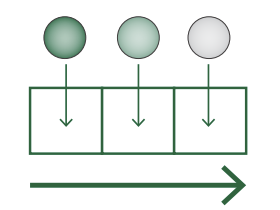
Elkonin Boxes (blending phonemes): Elkonin boxes are blank boxes used to represent a sound. A teacher pushes a block, a penny, colored dots, or any other manipulative into the empty boxes to represent sounds as they segment each sound in a word. For instance, the below visual shows Elkonin boxes with colored dots being pushed into each box as the sound is segmented. For example, a teacher could say, "I'm going to say a secret word, but you have to try and put our sounds together and blend to tell me what the word is. The word has three sounds: /h/ (pushing up one dot) /o/ (pushing up second dot) /t/" (pushing up third dot). Can you tell me what word I made?" You can watch a reading specialist use Elkonin boxes and pennies for a demonstration of blending.
Segmenting is separating two or more things into their smaller parts. Much like with rhyme and alliteration, segmenting has its own sort of scope and sequence that moves from segmenting larger sound units to smaller sound units. One sample activity is included for each of these skills:
Nursery Rhyme Blending (sentence segmenting): Once students have been exposed to a number of nursery rhymes, tell them you will play a game. You are going to say a line from a nursery rhyme. The students must listen and then segment the line into the words, using a finger to count each word as they say it (EX: Teacher reads fluid line: "One, two buckle my shoe." and students respond "One----- two---- buckle---- my-----shoe" (5 words, holding up a finger for each word as they count/say it).
Compound Word Segmenting (segmenting compound words into component words): In advance, find pictures of compound words. The literacy portal has a set of compound word cards. Place one compound word picture out on a pocket chart. Encourage students to try and name the picture for each compound word, but if they miss it be sure to give them the correct name. Then, see if the students can segment the compound word into the two component words (goldfish= gold + fish). You can have them then try and find pictures for the two component words.
Name Segmenting (segmenting words into component syllables): Tell students that you will be calling out their names for them to line up for lunch. However, explain that you will say their name and they must clap out each chunk in their name while saying it (EX: Samantha, Sa----man---tha!) in order to get in line.
Onset and Rime Segmenting (segmenting onsets and rimes): Tell the students they will be detectives trying to segment apart a word you say. Tell them you want them to put both fists together while saying the whole word, then remove one fist while saying the first sound and remove the other fist while saying the end part of a word. Use your hands to show and model this for them (EX: /Bat/ (put out both fists) /b/ (remove first fist) /at/ (remove second fist). Encourage students to do the same thing with their hands as they segment the next series of target onsets/rimes you give them. They may have an easier time with this the first time if you do all rhyming words (EX: start with /bat/ and then move through a number of others like cat, hat, rat, sat, mat).
Elkonin Boxes (segmenting phonemes): Elkonin boxes are blank boxes used to represent a sound. A teacher could have a student push a block, a penny, colored dots, or any other manipulative into the empty box to represent a sound as they segment each sound in a word. For instance, the below visual shows Elkonin boxes with colored dots being pushed into each box as the sound is segmented. For example, a teacher could say, "Our word is 'hot.' That has three sounds. See if you can push a dot into each of our three boxes below as you say each sound in 'hot' separately. /h/ /o/ /t/". You can watch a reading specialist use Elkonin boxes and pennies to progress to segmenting sounds.
Students are asked to manipulate large (such as syllables) or small (such as phonemes) sound units. There are three basic types::
Sound Unit Change (deletion of compound word): "I'm going to say a word, then I want you to try to take off a part of that word. My word is 'butterfly'. What would butterfly say if we took off 'butter'? Right, it would just say 'fly'."
Sound Unit Change (addition of word to make compound word): "I'm going to say a word. Then, I'm going to give you another word to add to it and see if you can tell me what new word it would make. My first word is 'dog.' What if we added the word 'hot' to the front of 'dog'. What would our new word be? Right, 'hotdog'."
Sound Unit Change (substitution of syllable): "Jajuan is a student in our class. His name has two syllables, Ja---jaun. What would his name change to if we replaced the 'jaun' in his name with 'ment'? Right, 'Jament'."
Sound Unit Change (substitution of onset/rime combo): "We have the word 'bat'. Remember how we used our fists to break apart a word into its first sound and end part? 'b'----'at'. What would happen if we kept our first part 'b' but replaced our second part 'at' with 'am'? Right, 'bam'."
Color Encoding (manipulating phonemes): Students have different color manipulatives such as cubes, construction paper squares, magnet tiles, etc. The teacher says a word and students build it with manipulatives, one sound at a time, using a different color for each sound. The teacher then prompts students to substitute/delete/add a sound in the beginning, middle or end. Students do so by swapping out one color block for another. Ex: "Show me fad. Now change /f/ to /t/." Students would swap the first color, representing /f/, for another color to represent /t/. During this activity, the instructor can add, delete, or substitute one sound at a time when going from the old word to the new word. This can be done at the 2 sound (cv, vc), 3 sound (cvc), 4 sound (ccvc, cvcc), or 5 sound level (ccvcc). The Lindamood Phoneme Sequencing (LiPS) program uses this technique and you can view it in action here: color encoding. Please note, the teacher in the above video eventually shifts from phonemic awareness (using the blocks to represent sounds) to phonics (using actual letters to represent sounds) over the course of her practice. The Really Great Reading website also has a free set of virtual blocks. After clicking on the link, click on the "basic tiles" tab in the lower left corner. The colored blocks will appear in the lower left corner and can be pulled up instead of letters on a Smartboard to practice phonemic awareness in the classroom.
Ready-to-print classroom toolkits from Educational Solutions for Children’s Birth–5 Literacy Resource Collection. Each one opens with a teacher welcome and a standards-alignment page (Birth–3, Preschool, Pre-K, Kindergarten), followed by activities, materials and observation tools you can use in whole-group, small-group, intervention, literacy-center and take-home settings.
Literacy Toolkit · 47 pages · PDF 6.5 MB
Phonemic Awareness
Helps young children hear, identify and manipulate the individual sounds in words through play-based, real-life sound activities — the foundation for decoding and spelling.
Literacy Toolkit · 45 pages · PDF 6.6 MB
Syllables
Activities for hearing, clapping, counting and blending syllables — the larger sound units children master before working with individual phonemes.
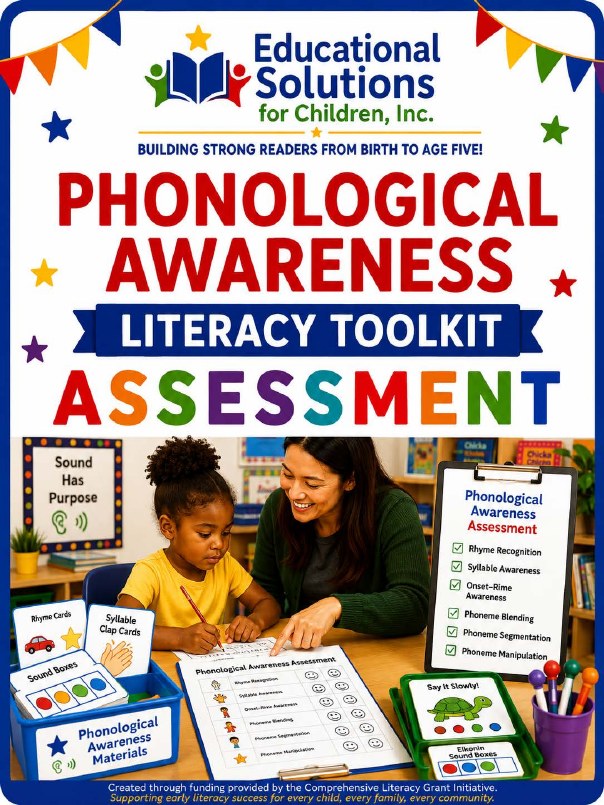
Assessment Toolkit · 15 pages · PDF 3.0 MB
Phonological Awareness Assessment
Quick, observational, research-based assessment tasks (each takes a few minutes) to identify what children can do, what they are ready to learn next, and how to plan targeted instruction and share learning with families.
The video library has short clips of real teachers and parents modelling every one of these skills with preschool and pre-K children.
A free, research-based home for the four practices that build readers before reading begins — written for preschool and pre-K teachers and the families they partner with.