Alphabet Knowledge
Knowing letter names, letter sounds, and how letters are formed.
Knowing letter names, letter sounds, and how letters are formed.
Letters are everywhere your child already looks. These are the small, repeatable things that turn that exposure into knowledge.
The letters in their own name are the ones they care about, so they are the easiest to learn. Point them out on signs, cereal boxes, and mail.
Knowing a letter is called M, knowing it says /mmm/, and being able to write it are separate skills. Children usually learn them in that order. Celebrate each one.
Trace letters in bath foam, sand, flour on a tray, or on a foggy window. Say the letter's name and sound while you trace. Big movements build the shape in memory before small pencil control arrives.
Chicka Chicka Boom Boom, Eating the Alphabet, and Dr. Seuss's ABC hold up to many readings. Ask "can you find the M?" — but only once or twice per book, so the story still feels like a story.
The alphabetic principle is the understanding that letters represent sounds and that sounds form words. Teaching alphabet knowledge (letter names, letter-sound correspondence, differentiating between upper and lowercase letters, letter formation) in preschool and pre-kindergarten builds the alphabetic principle and eventually gives students the skills they need to succeed with phonics in kindergarten and beyond.
Research outlines the importance of employing Structured Literacy Principles to teach key literacy skills (phonics, phonemic awareness, reading fluency, reading comprehension, vocabulary, spelling, writing) in a systematic, structured, cumulative, explicit and diagnostic fashion. The same structure applies to teaching emergent literacy skills (oral language, phonological awareness, alphabet knowledge, and print awareness).
Research is clear that emergent literacy is taught best when instruction follows the four Structured Literacy Principles. Here is what each one looks like for alphabet knowledge.
Instruction follows a logical order, begins with the easiest concepts, and progresses to more difficult concepts (EX: Teachers introduce easier skills such as alphabet recognition first and progress to more challenging skills such as teaching letter-sound correspondence.).
Each step must be based on concepts previously learned and continual review until mastery must be a part of practice. Systematic, sequential and cumulative learning enhance explicit instruction (EX: Remember a long time ago when we learned the /p/ sound and we said your lips popped out when you made that sound? This week we will learn another letter where your lips pop out to make the sound, /b/. The /p/ sound did not have much noise/vibration in your throat but the /b/ sound has a lot more. Put your hand on your throat as you make each sound so you can feel the difference).
Teachers use approaches such as gradual release of responsibility models (I Do, We Do, You Do) where the teacher models and students have multiple opportunities to practice with support and independently (EX: A teacher may model letter formation for a letter they are focusing on for the week. They might model tracing it in sand or shaving cream, talking out loud about what they do to form the letter correctly. Then, they may have students practice forming the letter in sand while they provide corrective feedback as needed. Finally, students may work independently trying write the letter at their desk on a whiteboard using a writing instrument).
Teacher assesses where students are, progress monitors as frequently as possible, diagnoses where skill gaps exist, and adapts instruction as needed (EX: uses an alphabet assessment to gauge students' skills and decide where to start alphabet knowledge instruction and regularly progress monitors alphabet knowledge skills so they know when to introduce a new letter or sound. Teachers can choose a project created assessment/CBM---uppercase alphabet, lowercase alphabet, letter sounds or an existing assessment---PALS, IGDI, Aimsweb to get to know their students).
Findings below are drawn from What Works Clearinghouse educator practice guides published by the Institute of Education Sciences, U.S. Department of Education.
The Works Clearinghouse (2022) report, "Preparing young children for school: Educator's practice guide," (pg. 54-61) indicates strong evidence for intentionally planning activities to build children's vocabulary and language; building children's knowledge of letters and sounds; using shared book reading to develop children's language, knowledge of print features, and knowledge of the world. From these three recommendations, building children's knowledge of letters and sounds is the most relevant to the alphabetic principle. The WWC report recommends a range of letter/sound awareness activities for introducing new letters and sounds, connecting the letter to words/pictures/experiences, practicing identifying letters/sounds, reading books targeting letters/sounds, including print throughout the classroom, etc. https://ies.ed.gov/ncee/WWC/Docs/PracticeGuide/TO4_PRACTICE_GUIDE_Preparing-for-School_07222022_v6.pdf
Example 6.1. Activities that can be used to discuss letters
Source: What Works Clearinghouse (2022), Preparing Young Children for School.
The What Works Clearinghouse (2016) practice guide, "Foundational skills to support reading for understanding in kindergarten through 3rd grade: Educator's practice guide" (pg. 29-37), indicates strong evidence for "teaching students to decode words, analyze word parts, and write and recognize words." Although this recommendation focuses on a later skills (phonics/phonemic awareness), it is relevant to the alphabetic principle as students first learn letter sound correspondences in preschool and pre-kindergarten and then eventually learn more advanced sound patterns when they get to kindergarten and beyond (consonant digraphs like sh, th, ch or vowel patterns like vowel teams). Advanced pre-kindergarten students may eventually be ready for some of these advanced sound patterns such as ch, th, sh if they have mastered all their basic letter-sound correspondences. https://ies.ed.gov/ncee/WWC/Docs/PracticeGuide/wwc_foundationalreading_040717.pdf The report includes a range of useful information from sound/syllable patterns (see below screenshot sample):
Common sound–spelling patterns
| Category | Pattern | Examples |
|---|---|---|
| Consonant patterns | Consonant digraphs and trigraphs (multi-letter combinations that stand for one phoneme) | th, sh, ch, ph, ng tch, dge |
| Blends (two or more consecutive consonants that retain their individual sounds) | scr, st, cl, ft | |
| Silent-letter combinations (two letters; one represents the phoneme, and the other is not pronounced) | kn, wr, gn, rh, mb | |
| Vowel patterns | Vowel teams (a combination of two, three, or four letters standing for a single vowel sound) | ea, oo, oa, igh, eigh |
| Vowel diphthongs (complex speech sounds or glides that begin with one vowel and gradually change to another vowel within the same syllable) | oi, ou | |
| R-controlled vowels or bossy r’s (vowels making a unique sound when followed by r) | ar, er, ir, or, ur | |
| Long e | ee, ie, ea, e_e, ey, ei, y, ea | |
| Long a | a_e, ai, ay, a_y, ei, ea, ey | |
| Syllable-construction patterns | Closed syllables (a short vowel spelled with a single vowel letter and ending in one or more consonants) | in-sect stu-dent |
| VCe (a long vowel spelled with one vowel + one consonant + silent e) | com-pete base-ball | |
| Open syllables (ending with a long vowel sound, spelled with a single vowel letter) | pro-gram tor-na-do | |
| Vowel team (multiple letters spelling the vowel) | train-er neigh-bor-hood | |
| Vowel-r (vowel pronunciation changing before /r/) | char-ter cir-cus | |
| Consonant-le (unaccented final syllable containing a consonant before l followed by a silent e) | drib-ble puz-zle |
Source: What Works Clearinghouse (2016), Foundational Skills to Support Reading for Understanding in Kindergarten Through 3rd Grade.
The general progression of skills from most basic to most difficult is below. However, keep in mind that some skills can/may be taught simultaneously (EX: while working on letter recognition and identification you could also teach letter formation, this just may be a harder skill for students to grasp at the time and make take further practice and separate introduction to stick; EX: a teacher may choose to introduce the uppercase and lowercase version of a letter simultaneously, but the student to be able to differentiate between the two or produce the uppercase/lowercase when directed).
1. Alphabet Recognition
2. Alphabet Identification
3. Differentiating Upper and Lowercase Letters
4. Letter Sound-Correspondence
4. Letter Formation
Each skill is outlined below, with sample activities to target each skill. A more comprehensive list of sample activities is available via the "alphabet knowledge" tab on the literacy portal.
Alphabet recognition is a receptive skill where students match a letter to a name (EX: Teacher places out three letters and asks the student to recognize which one is the letter "b").
Reading Alphabet Books: Reading a wide variety of alphabet books regularly is one of the best early ways to expose students to letters and practice letter recognition. Books such as Dr. Seuss's ABC, Chicka Chicka Boom Boom, Eating the Alphabet, Alphabet Soup, Animal Alphabet, and Alphabet Under Construction are great options to read daily. As you read these books more and more, engage students in recognizing or identifying letters.
Explicit Letter Introduction: Gradually introduce letters explicitly over the course of the school year. Introduce the letter by modeling how you look for features to identify it in a book or in the morning message, writing it on the board or tracing it in sand or shaving cream while talking out loud about how you form it. Then, give students opportunities to practice the letter (i.e., sorting letters, tracing them in the sand, picking the letter you say out of a series of 2-3 letters, identifying the letter in a book, etc.) with guidance. Then, provide opportunities for students to experiment independently with letters in the writing center, during open journaling, when sharing the pen during morning messages, creating the letter using playdough, etc.
Morning Message: Regularly completing a Morning Message is an excellent way to expose students to letters while also teaching them that print carries meaning, sentences are made up of words, words are made up of letters, letters make sounds, etc. As this becomes a regular activity, it is great for inviting students up to find a certain letter, say a letter they know, or even share the pen to fill in a missing letter.
Alphabet identification is an expressive skill, as students are asked to identify/name a specific letter (EX: Teacher holds up individual letter and student names letter).
Letter Hunt: Read a book like "Detective Dog" to introduce students to the idea of a detective. Explain that the students will be "letter detectives" for the day. Hide a particular letter around the room. Provide the students with clipboards, paper, magnifying glasses, etc. to go on a letter hunt. Students can either put a check on their clipboard every time they find the target letter or try to write the letter if they are capable. You can also encourage them to try to find the letter in the environmental print or labels in the classroom.
Alphabet Jumping Beans: This activity was first included in the Creative Curriculum. If you don't have access to this activity, it is easy to make your own alphabet jumping beans deck. Make an alphabet card deck (with each uppercase letter you have introduced to students so far on a card). Also make some cards with visual depictions of a jumping bean and mix them in with the alphabet cards. Students then turn over a card. If it is a letter, the student (or class) identifies/names it. If a jumping bean comes up, all the students jump. You can play this game with a smaller group of students whereby the students keep any card they name and then must return all their cards if they draw a jumping bean.
Once students learn to recognize and identify letters (generally starting with uppercase letters in preschool/pre-k), they will need to learn to recognize and differentiate between uppercase and lowercase letters since they will be exposed to both in words, writing and texts.
Uppercase and Lowercase Sort: Sorting is a great activity to get students differentiating between uppercase and lowercase letters. You could sort for just one letter (i.e., create cards with multiple versions of the uppercase letter and lowercase letter and students sort into one uppercase pile and one lowercase pile) or you could sort all the letters students have learned so far (i.e., making uppercase and lowercase cards for all the letters students have been introduced to so far and having them sort into uppercase and lowercase piles).
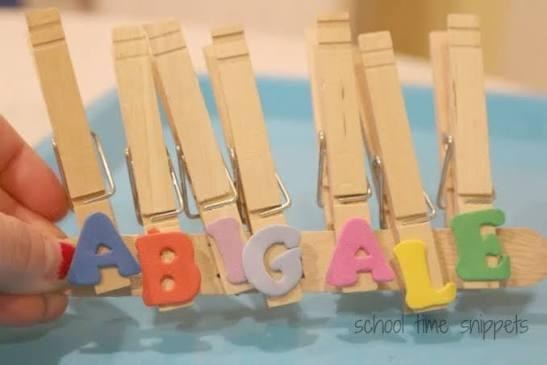
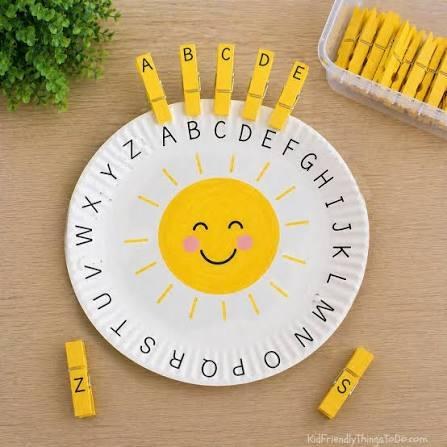
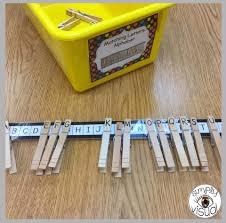
Paint Stick/Clothespin Matching: Use the free Home Depot or Lowe's paint stirs to create upper and lowercase matching activities. Use a sharpie to write 4-6 uppercase letters on the paint stir. Then, write the same 4-6 uppercase letters on the end of a clothespin (or glue foam/plastic uppercase letters to the end of the clothespin as pictured below). Students then must match the uppercase letter on the clothespin to the uppercase letter on the paint stir, clipping it in place. Do the same for lowercase letters. Something similar could be used instead of a paint stir, such as a paper plate or simple alphabet strip (pictured below):
Photos: school time snippets, Kid Friendly Things To Do, Simply Kinder.
As children begin to prepare to learn to read and write they need to learn that words are made up of letters and that those letters make sounds that help determine the spelling of the word. Teachers can/should teach letter/sound correspondence directly and explicitly by teaching the sound each letter makes, but they should also reinforce this skill indirectly through shared reading/writing (EX: pointing out the sounds letters make in books, talking out loud while sounding out words to write a morning message, etc.).
Alliterative Book Reading: Reading an alliterative book (Zippy the Zebra, Monkey's Miserable Monday, etc.) is a great way to hit multiple skills at once (oral language due to new vocabulary in the book, phonological awareness due to listening/detecting words with the same beginning sound, and alphabet knowledge by teaching letter-sound correspondence for a particular sound. You can start by reintroducing students to the letter ("Remember when we learned about the letter M? This is what it looks like, here is the uppercase version and the lowercase version. Today, we will also talk about the sound M makes when you see it in words\! It says /mmmmm/, just like the noise you make when something tastes good\! Our story today, 'Monkey's Miserable Monday' has lots of words with the letter M and the sound /mmmm/. You can help tell me which words have that sound.").
Sound Sort: Once students know more than one letter sound, sound sorts are a great way to review letter-sound correspondence and differentiate between letters and sounds. Simply write the two letters on notecards, review/introduce the sound of each letter again, and then provide pictures that start with the sound the two letters are making. Students sort the word cards based on the beginning sound the picture starts with. There are sound sorting cards among the materials on the literacy portal. This activity words alphabet knowledge (letter sounds) as well as phonological awareness (identifying beginning sounds).
Practicing letter formation builds a foundation for future writing skills by developing fine motor skills, improving letter recognition, and reducing writing/mental fatigue down the line. Learning to write using the correct letter strokes will make writing easier and free up brainpower for written expression.
Multisensory Letter Formation: Use something like sand or shaving cream to model proper letter formation for students. You dictate the correct formation as you trace it in the sand or shaving cream, and then invite the students to do the same (EX: "Today we will practice uppercase B. I start at the top and draw a straight line down. Then, I lift my finger and go back to the top to draw a curve/bubble out the right and then a second curve/bubble below that. Now you try. Let's say it as we do it. Start at the top and draw a straight line down…").
Sandpaper Letter Tracing: Use stencils to draw/cut out sandpaper letters. Use a sharpie to put some arrows on them indicating the proper way to write/form the letter. Model tracing the sandpaper with your finger. Following the arrows. Then, ask the student to do the same. Afterwards, see if they can retrace the letter using the proper strokes in sand/shaving cream or try writing it on a piece of paper.
Ready-to-print classroom toolkits from Educational Solutions for Children’s Birth–5 Literacy Resource Collection. Each one opens with a teacher welcome and a standards-alignment page (Birth–3, Preschool, Pre-K, Kindergarten), followed by activities, materials and observation tools you can use in whole-group, small-group, intervention, literacy-center and take-home settings.
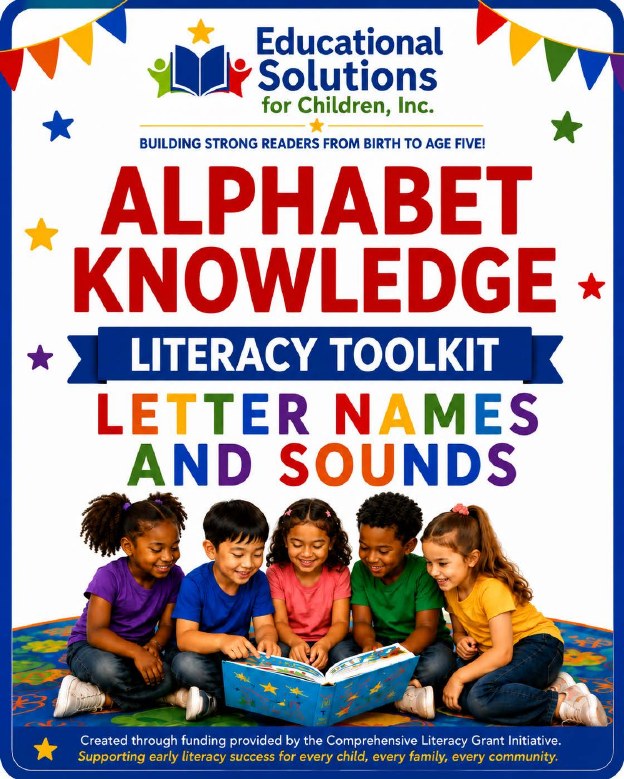
Literacy Toolkit · 172 pages · PDF 18.7 MB
Letter Names and Sounds
A complete alphabet toolkit for teaching letter names, shapes and sounds through play, songs, games and meaningful practice, with assessment tools to track progress — explicit, systematic instruction in the alphabetic principle from birth through age five.
The video library has short clips of real teachers and parents modelling every one of these skills with preschool and pre-K children.
A free, research-based home for the four practices that build readers before reading begins — written for preschool and pre-K teachers and the families they partner with.