
Oral Language
Building the vocabulary and conversation that reading comprehension rests on.
Building the vocabulary and conversation that reading comprehension rests on.
Conversation is the single most powerful literacy tool you own, and it is free. Here is how to get the most out of it.
Narrate what you're doing while you cook, drive, or fold laundry. Children learn words from hearing them used in real situations, many times, by people who love them.
Don't swap enormous for big. Say "that truck is enormous — enormous means really, really big." Rich words offered with a quick child-friendly definition are how vocabulary grows.
"What do you think happens next?" and "why do you think she did that?" pull far more language out of a child than "did you like it?" Then wait. Young children need several seconds to answer.
If you speak a language other than English at home, keep speaking it. A strong first language makes learning English easier, not harder — and it is what your child's grandparents, stories, and songs live in.
Oral language involves the ability to communicate in a meaningful way. Oral language includes:
There are three primary components to oral language: form, content, and use (Bloom and Lahey, 1978)
Children are born with an innate capacity to attain language. In contrast, most children need direct instruction to acquire literacy skills. However, it is important to note that children must hear plenty of language and must experience as many chances to interact with others as possible to be able to successfully use language. Reading and writing are deeply rooted in oral language (i.e., oral language capabilities influence one's ability to read/write effectively)
These are five phases of second language acquisition (Krashen & Terrell, 1983), which are increasingly important to consider when supporting English learners (ELs) as they acquire language:
The below table outlines these phases and recommends types of questions that might be most appropriate for each phase.
| Stage | Characteristics | Teacher Prompts |
|---|---|---|
| Pre-production | Has minimal comprehension; does not verbalize; nods "Yes" and "No;" draws and points. | Show me …, Circle the …, Where is … ?, Who has … ? |
| Early Production | Has limited comprehension; produces one- or two-word responses; uses key words and familiar phrases; uses present-tense verbs. | Yes/no questions, Either/or questions, Who … ?, What … ?, How many … ? |
| Speech Emergence | Has good comprehension; can produce simple sentences; makes grammar and pronunciation errors; frequently misunderstands jokes. | Why … ?, How … ?, Explain …, Questions requiring phrase or short-sentence answers |
| Intermediate Fluency | Has excellent comprehension; makes few grammatical errors. | What would happen if … ?, Why do you think … ?, Questions requiring more than a sentence response |
| Advanced Fluency | The student has a near-native level of speech. | Decide if …, Retell … |
Although Structured Literacy principles are often applied more to early literacy skills (phonics, phonemic awareness, reading fluency, vocabulary, spelling, writing) the same principles can be applied to teaching emergent literacy skills (oral language alphabet knowledge, print awareness, phonological awareness). So, oral language should also be taught in a systematic, structured, cumulative, explicit and diagnostic fashion.
Research is clear that emergent literacy is taught best when instruction follows the four Structured Literacy Principles. Here is what each one looks like for oral language.
Instruction follows a logical order, begins with the easiest concepts, and progresses to more difficult concepts (EX: Teachers may start by introducing a word in the context of a story, providing a child friendly definition. Next, the teacher may invite the students to act out the word meaning with a partner, providing them with a gesture or movement to use. Finally, the teacher may ask students to use the word in context with a question like "Tell me about a time when you were _______.")
Each step must be based on concepts previously learned and continual review until mastery must be a part of practice. Systematic, sequential and cumulative learning enhance explicit instruction (EX: "Remember last week when we learned about animals? This week we are going to learn about a specific group of animals called insects. Insects are sometimes called bugs, can you name any bugs?").
Teachers use approaches such as gradual release of responsibility models (I Do, We Do, You Do) where the teacher models and students have multiple opportunities to practice with support and independently (EX: A teacher might read a book aloud and provide a child friendly definition during the read aloud. "I saw this word 'afraid' in our book today. Being afraid is the same as being scared. That is when you see something kind of scary like a ghost and get this worried feeling." Next, the teacher may practice with the students, providing guidance. "Tell me something that might make you afraid, and tell me why it scares you or makes you afraid." Finally, the teacher may encourage independent practice. "Think of a time when you were afraid of something. Then, turn and talk with a partner to tell them about what it was and why you were afraid." ).
Teacher assesses where students are, progress monitors as frequently as possible, diagnoses where skill gaps exist, and adapts instruction as needed (EX: To start the year, a teacher administers a language assessment or reviews school language data. Based on overall classroom data, the teacher picks which level to start at and which skill in the oral language scope and sequence to start with. In addition, the teacher may use individual student data to plan which skills to practice in one-on-one or in small group based on student needs.).
Findings below are drawn from What Works Clearinghouse educator practice guides published by the Institute of Education Sciences, U.S. Department of Education.
The What Works Clearinghouse (2022), "Preparing Young Children for School: Educator's Practice Guide.," indicates "strong evidence" for intentionally planning activities to build children's vocabulary and language as well as "strong evidence" for using shared book reading to develop children's language, knowledge of print features, and knowledge of the world (pgs. 47-53 and pages 62-68):
Download this IES practice guide (PDF)
Specific strategies for explicit oral language instruction were identified such as: choose 3-5 unique words to focus on each week and include review of those words in other weeks; explicitly introduce words and meanings; give examples of words and practice them (acting them out, gesturing); engage in interactive conversations to reinforce vocabulary; selecting a variety of narrative and informational books appropriate for 3-5 year olds; plan a purpose for reading prior to reading and identify this purpose (EX: Today we will read about three goats trying to cross a bridge protected by a mean troll. As we read, I want you to try and listen for things the goats do to outsmart the troll."); read the same book multiple times for different purposes; pick stopping points to discuss something or ask a question; prepare children for listening to and discussing content prior to reading; engage in questions during reading, increase complexity of questions over time or over repeated reading of the same text;
Example 5.1. A teacher and child discuss the word silent
Teacher: “Can you think of a time you were silent?”
Sam: “I was silent when I was sleeping.”
Teacher: “You said you were silent when you were sleeping. That means that when you were sleeping, you were so quiet you were not making ANY noise!”
Source: What Works Clearinghouse (2022), Preparing Young Children for School.
Example 7.1. Three readings of the same book for different purposes
Time 1: Read the entire book so children can hear the whole story or all the content.
Time 2: Point out and discuss vocabulary, letters, and other interesting parts of print, such as the table of contents.
Time 3: Review some letters and vocabulary and engage in a conversation or an activity based on the topic of the book.
Source: What Works Clearinghouse (2022), Preparing Young Children for School.
Example 7.3. Questions that increase in complexity
Questions that can be answered by looking at the pictures:
Questions that can be answered by making connections between the pictures or parts of the book:
Questions that can be answered by connecting what children know to what happened in the book:
Source: What Works Clearinghouse (2022), Preparing Young Children for School.
The What Works Clearinghouse report, "Teaching academic content and literacy to English learners in elementary and middle school: Educator's practice guide" indicates "strong evidence" for teaching a set of academic vocabulary words intensively across several days using a variety of instructional activities (pgs. 20-37, portions of the report excerpted below):
Download this IES practice guide (PDF)
Specific strategies for teaching academic vocabulary were identified such as: using an engaging informational text to teach a small set of academic vocabulary; picking academic vocabulary that met certain criteria; providing student friendly definitions, using examples and non-examples of the words, matching sentences to word meaning for multiple meaning words, teaching word learning strategies (cognates, pictures, gestures).
Children acquire language in many different ways. Much of language acquisition occurs indirectly or in context (i.e., children learn new words through conversations, listening to read alouds, reading on their own). However, children also need explicit, direct instruction to learn challenging words. Using a gradual release model (I Do, We Do, You Do) to teach oral language is the most effective form of explicit instruction.
Giving a broad category like oral language a scope and sequence can be challenging, but in general instruction should use a mix of indirect and direct/explicit methods. A possible scope and sequence is outlined below:
Each skill is outlined below, with sample activities to target each skill. A more comprehensive list of sample activities is available via the "oral language" tab on the literacy portal. The "vocabulary" portal for the K-5 CLSD grant also has activities and resources for advanced pre-k students and K-5 students.
Language acquisition in preschool and pre-kindergarten students thrives through play-based oral language activities and storytelling. These foundational strategies—such as interactive read-alouds and dramatic play—build vocabulary and conversational skills in a natural, engaging way.
Read Alouds (with child friendly definitions, gestures or total physical response, think alouds, open-ended questions, and cooperative learning): Good teachers think aloud as they read, wondering why characters do things or stating what they think might happen next. Additionally, good teachers anticipate words students might not know, and make the words easier to learn by acting them out, providing a child-friendly definition, or engaging students in discussions that increase understanding of vocabulary. Review this interactive read aloud to see all of these strategies put into practice. Visual of key things to consider when introducing a word in context:
Introducing a word in context: teacher triggers for the target word “despise”
| Target Vocabulary | Teacher Triggers |
|---|---|
| Word 1: despise | |
| Contextualize the word within the story | Pages 2, 3: “How did Alexander feel when he saw his father for the first time in his life?” |
| Provide a child-friendly explanation of the word. | Despise means to hate or dislike. |
| Have children say the word. | Say it with me: “Despise. Let’s say it as if we really dislike something: I despise broccoli! What kind of face would we make?” |
| Present examples of the word used in contexts different from the story. | Despising broccoli, despising work, despising a mess. You could always provide non-examples too (“I DON’T despise ice cream or pizza). |
| Engage children in activities that get them to interact with the word after reading the story. | Describe something you despise (NOT A PERSON, but something you don’t like) and explain why you don’t like it. Ask the children to think of a food they might despise. |
Facilitating Language During Centers: Children can learn a great deal from adults during centers. The teacher's goal is to serve as a facilitator during centers/dramatic play by circulating the centers to provide information (EX: "I see you are building a tall building out of blocks. That looks like some of the tall buildings I have seen in the city. You know another word for tall buildings you see in the city? Skyscrapers. Are you two building a skyscraper?"), prompt thought processes (EX: "I wonder what we could use to pretend like we are checking our patient's heartbeat? Can you think of anything? There is something called a stethoscope, that you can use to hear someone's heartbeat. I think we have one with our doctor's costume, see if you can find it."), ask open-ended questions (EX: "What are you building?" "Why do you think the block tower fell down?"), use parallel talk (EX: "I see Jalen measuring out some flour to make pizza dough. I see Jalen kneading the dough. I see Jalen putting sauce, cheese and toppings on his pizza."), encourage students to brainstorm or create (EX: "Before we go play, let's make a plan of what we will do today in the dramatic play." Or "We have aprons and measuring cups and spatulas in dramatic play today. What could we make?"), make real world connections ("The seeds in our science center are growing! All they needed was some sun and water! Have you ever grown anything at home? Have you gone to a place where they grow things? Good, yes they grow a lot of food on farms."), compare and contrast (EX: "How are Thomas' and Deirdre's block towers different? How are they the same?), ask students to explain their thinking (EX: "Why did you put those extra blocks around the base of your tower?"), provide specific feedback (EX: I love how carefully you are stacking your blocks. You have them so straight on top of each other I think your tower will last longer."), and engage in back-and-forth exchanges (EX: Teacher: "Tell me how you made your pancakes?" Student: "Flour". Teacher: "Oh right, pancakes do have flour in them. Did you add anything else? Student: "Eggs". Teacher: "Great thinking, pancakes have eggs too. You need wet ingredients like milk and eggs to soak up all that dry flour. What did you do once you put the eggs and flour and other ingredients together?" Student: "Mixed it." Teacher: "Great, yeah you need to mix it so it does not have big lumps of flour. Look, here is a spatula for when you need to flip your pancakes on the stove."). ALL OF THESE PRACTICES ARE ALIGNED WITH THE CLASS OBSERVATION, AND WILL RESULT IN HIGHER SCORES ON CLASS IF YOU PUT THESE INTO PRACTICE.
Following directions and receptive vocabulary activities build a child's ability to understand spoken language, follow multi-step routines, and grasp spatial or descriptive concepts. These skills form the foundation for reading comprehension and active classroom participation.
Listening Bingo: The teacher creates bingo cards that feature pictures of themed vocabulary in each square (EX: animal pictures). Each student has their own bingo card and some pennies or stickers to place over pictures as they are called. The teacher could either: A) say the animal word verbally and students must track to see if it is on their bingo card, placing a penny or sticker on it if it is on their card OR B) Turn over a picture, encourage the students to name the picture and then see if they have it on their card (alternatively, the teacher can name the picture to keep this more receptive).
Barrier Games: Provide each child with identical sets of blocks or toys and a physical divider. One child (or the teacher) builds a structure and describes how to build it step-by-step (e.g., "Put the green block on top of the blue block") while the other must listen and follow the directions
Adapted "Simon Says": Use the classic game to focus on specific vocabulary. For example, focus on action verbs ("Simon says run like a cheetah" or "Simon says jump like a kangaroo.") or positional words ("Simon says put your feet under the table" or "Simon says to put your hands over your head).
Seek It!: Hide small items (like blocks) under or behind objects (like cups, books, bowls). Give specific directional prompts, such as "Find the rectangular block under the red bowl" or "Find the paperclip behind the book".
Increasingly Difficult Oral Directions!: Put out a series of items that each student or a group of students could use to follow oral directions. Start with simple, one-step directions ("Place the penny on the paper"). When students increase their listening and sequencing skills, increase to 2, 3, and 4 step directions.
Fostering expressive vocabulary and verbal responses in preschool and pre-kindergarten requires consistent, back-and-forth conversational scaffolding. By utilizing interactive read-alouds, open-ended questions, intentionally modeling advanced "academic" vocabulary during play, encouraging children to use new vocabulary in context, and employing expansion strategies; educators and caregivers can significantly boost a child's expressive vocabulary and verbal responses. Teachers and parents should constantly engage in rich interactive conversations rather than simply directing conversations.
Language Expansions: When a child uses a simple phrase, repeat it back with richer, more descriptive vocabulary. If they are drawing a journal picture and say, "The dog is running," you can respond with, "Yes, I can see your energetic energetic dog is sprinting across the yard!" THIS STRATEGY DIRECTLY ALIGNS TO THE CLASS OBSERVATION AND WILL RESULT IN HIGHER TEACHER SCORES.
Self and Parallel Talk: Narrate your own actions (self-talk) or the child's actions (parallel talk) to explicitly model new verbs and adjectives in the moment. You can do this at any time during the day, such as center time (PARALLEL TALK EX: "I see Jayden is building a gigantic tower in the block center. I see Jayden's building is big and tall like a skyscraper" & SELF TALK EX: "I'm helping my friends in the writing center. I'm picking up a piece of paper so I can help James start a shopping list. James said he wants apples so I am writing apples. A-a-a-aples starts with an /a/ sound so I am writing my 'a' first." THIS STRATEGY DIRECTLY ALIGNS TO THE CLASS OBSERVATION AND WILL RESULT IN HIGHER TEACHER SCORES.
Pretend Play Narratives: Set up real-world scenarios (e.g., a grocery store or restaurant) and engage in character-driven role-play. This encourages the use of descriptive language in context.THIS STRATEGY DIRECTLY ALIGNS TO THE CLASS OBSERVATION AND WILL RESULT IN HIGHER TEACHER SCORES.
Question of the Day (with sentence frames for English learners): Use morning meetings to ask opinion-based or narrative-based questions. Provide sentence starters for students with limited language skills, particularly English learners (e.g., "I like the character in our story because ___________") to help them practice complete sentences.
Dialogic Reading: The adult then assumes the role of an active listener, asking questions, adding information, and prompting the child to increase the sophistication of his or her description of the material in the picture book. As the child becomes more skillful in the role of storyteller, the adult is encouraged to ask open-ended questions and avoid yes-no pointing questions" (Whitehurst et. al., 1994). Whitehurst's dialogic reading program, "Read Together, Talk Together" outlines five basic steps:
Steps for Dialogic Reading
During steps #2, #3, and #4 listed above, the adult will use the PEER sequence outlined below to engage children in conversation about the book:
PEER Sequence for Engaging in Discussion
P- Prompt: The adult should prompt the children to talk about something on the page by asking a question. For example: "Why do you think the goat has such long fur?"
E- Evaluate: The adult should evaluate what the child says by giving a correct answer or gently correcting the child's answer. For example: "Maybe the goat likes to keep its fur long, but I think it might have long fur to keep warm."
E- Expand: The adult should expand on the child's response, giving more information to engage in further discussion or build background knowledge. For example: "This goat is called a mountain goat. It lives high up in the mountains, where it is very cold and even snowy. The mountain goat needs to have such long fur so it can keep warm."
R- Repeat: The adult should ask the child to repeat the correct response. For example: "What is this animal called? Why is it called a mountain goat? Why does it have such long fur?"
As students become more familiar with books and get used to talking about books, adults can use more sophisticated, open-ended questions. "Read Together, Talk Together" outlines the CROWD sequence for asking advanced questions, especially on 2nd or 3rd reads of a book:
C- Completion: The adult asks the child a completion question. A completion question is one that asks a child to complete a sentence or phrase. For example: "The dog shook its fur and ___________." Early on, completion questions should be easy one word completions that can be quickly answered by looking at pictures. However, as time goes on, adults can ask completion questions that require the child to fill in a few words or a phrase. Children should gradually become skilled enough to answer completion questions without relying on pictures.
R- Recall: The adult asks the child to recall a detail from the story. This can occur during the story (with the recall question referring back to a previous page) or after the story (with the recall question referring back to any detail from the beginning, middle or end of the story). For example: "What happened to the bear when he woke up from his nap?" Recall questions can be phrased as more open-ended questions too. For example, asking a student "What happened in that story?" would leave them with an "open" opportunity to recall what happened in the story.
O- Open-Ended: The adult asks the child an open-ended question. An open-ended question is one that gives the student a lot of "space" to determine a response, talk about story ideas, and express his opinion. For example, if an adult asks a student: "Tell me about this picture," a student should respond by describing the picture, without any guidance. Such a question would leave options "open" to the student to discuss or interpret any item on the page that interested him. However, close-ended questions guide students' language and response patterns. An example of a close-ended question would be: "What is the mountain goat doing?" Such a question guides the student, and has only one correct , limited response.
W- Wh Questions: The adult asks the child a wh question (who, what, when, where, or why). For example: "Who stole the acorn from the squirrel?"
D- Distancing: The adult asks the child a distancing question. A distancing question is one that tries to connect a book to something in the child's life. For example, if reading a story about making pizza, an adult might ask: "Have you ever made a pizza at home? How did you make it?" Or, if reading a story about a house, an adult may say: "The man in the story lived in a big red house. How many of you live in a house? How many of you live in an apartment?"
Final Tips:
THIS STRATEGY DIRECTLY ALIGNS TO THE CLASS OBSERVATION AND WILL RESULT IN HIGHER TEACHER SCORES.
Building conversations with preschool and pre-K students relies on child-led topics, active listening, play-based scaffolding, and guided opportunities to talk with a peer. Adults can nurture meaningful dialogue and social interactions by using open-ended questions, modeling conversational turns, and embedding peer-peer and peer-adult communication into daily routines.
Story Retelling: Create some pictures, scenes or props from a frequently read story. Have children work with a peer to arrange story-cards in chronological order and retell the story to their peer, acting out familiar portions. Alternatively, a student or group of students could complete this activity with a teacher in whole group, small group, or 1-1 format.
Turn and Talk or Think-Pair-Share: Students learn as much language from their peers as they do adults, especially when adults provide scaffolding for students to be successful with peer conversations. For a turn and talk, a teacher simply asks a question and encourages students to turn and talk with a peer (EX: "Turn and talk to a friend about what you think the pig will do to outsmart the fox."). Think-pair-share is similar, as a question is posed to students and they are given think time prior to sharing their thoughts/response with a peer. THIS STRATEGY DIRECTLY ALIGNS TO THE CLASS OBSERVATION AND WILL RESULT IN HIGHER TEACHER SCORES.
Use the TALK Strategy: This strategy can be used during any segment of the day to extend and enrich conversations. The strategy is highly aligned with the Classroom Assessment Scoring System's Quality of Feedback domain since this strategy encourages multiple back-and-forth exchanges between the adult and child. A teacher could use this strategy any time during the school day (arrival, transition, centers, during read aloud):
T - Tune In: Observe what the child is doing or looking at and engage in their current interest. Start the conversation by commenting on what they notice, such as "I see..." or "I noticed you...".
A - Ask Questions: Move beyond "yes" or "no" answers by asking open-ended or choice-driven questions (e.g., "Why do you think our bean plant is dying?"). This sparks critical thinking.
L - Lift Language: Expand on what the child says. Model complete, well-formed sentences and naturally introduce more complex or descriptive vocabulary to build their expressive language (e.g., Student: "Dry". Teacher: "You are right! Plants need water to live and the soil around this bean plant is dry."
K - Keep it Going: Maintain back-and-forth conversational turns. Give the child ample time to respond, process, and practice using their own words (e.g., what else do you think our bean plant needs to be healthy?").
Class connections and integrated vocabulary refer to teaching methods in preschool and pre-K where new words are directly linked to real-life experiences, play, and specific themes rather than taught in isolation. This approach helps young children naturally attach meaning to complex words. Instead of just memorizing a definition, children experience the word physically, socially, and visually, making the learning long-lasting. It challenges educators to use Tier 2 and Tier 3 vocabulary (e.g., using "construct" instead of "build" or "exhausted" instead of "tired").
Thematic Curriculum: Many curricula have existing built in themes. These built in themes help students to construct "schemas" (an organized framework of prior knowledge and experience used to interpret the world) to organize vocabulary and background knowledge. For example, if a curriculum has a transportation theme students might learn to group transportation by type (land---car, bicycle, motorcycle, truck, train, skateboard, rollerblades; sea—boat, kayak, canoe, tanker, barge; air—airplane, helicopter, glider), learning new vocabulary associated with each type of transportation. If your curriculum does not already have built in themes, you can use thematic planning sheets as a starting point to think through vocabulary, experiences, and books you may use to target the theme. Here is a sample five senses thematic planning sheet as well as a blank thematic planning sheet.
Total Physical Response: Total physical response is the practice of acting out vocabulary words or associating a gesture or physical motion with vocabulary words. This practice works particularly well for English learners. You can watch total physical response in action to get a sense of how this practice is implemented.
Embed Thematic Vocabulary Into Centers: For instance, if the class is doing a "building" theme find ways to introduce words like architect, designer, model, building, skyscraper, scaffold, etc. into center time play (integrate pictures with names written underneath in English or another language, encourage children to use the word in the center---"Who is the architect designing our building today?", or draw—"Who is going to draw up a model of the building you plan to build in the block center?").
Academic Vocabulary Wall: Create a word wall for each center with relevant academic vocabulary learned during a theme or unit. For instance, if a bean plant is being grown in the science center there might be a labeled picture depiction, the words and definitions/pictures for the words observe, record, water, light, photosynthesis, roots, leaves, stems, etc.
Decontextualized language skills refer to a child's ability to use and understand language that is removed from the "here and now." Instead of relying on immediate physical objects, visual cues, or gestures to convey meaning, children must use their words to describe things outside of their immediate environment. Developing these skills is highly critical during the preschool and pre-K years. Early research shows that a child's ability to engage in decontextualized conversations strongly predicts later reading comprehension and academic success throughout their schooling.
Modeling Inferencing: Students learn a lot of decontextualized language from their teacher or parents. Teachers and/or parents can model how they make inferences as they do many things (as they read, prior to going on a field trip, after going on a field trip, during everyday interactions, etc.). For instance, a teacher could model how they infer something during a read aloud. The teacher may be reading "The Snowy Day" by Ezra Jack Keats and comment: "Woah, I see the child on the cover of our book wearing a thick hat and coat. I also see him looking back at shoeprints in the snow. Based on what I see, I think I can guess or infer that this child is outside in the cold during the winter. His thick coat and hat tell me it must be cold and the snow tells me it is probably winter."
Comparison and Contrast: Teachers or parents can model how they compare and contrast things on a regular basis (during read aloud, during classroom experiences, in centers, out in the world, etc.). For instance, a teacher may read two different versions of The Three Little Pigs over the course of two weeks (the original version as well as The True Story of the Three Little Pigs!). The teacher will lead the students through a comparison of the two books, pointing out similarities and differences and prompting students to notice any similarities or differences. THIS STRATEGY DIRECTLY ALIGNS TO THE CLASS OBSERVATION AND WILL RESULT IN HIGHER TEACHER SCORES.
Teaching Different Items in Categories or Parts vs. Whole: Again, this is best done in the context of reading books, learning thematic vocabulary, or experiences such as field trips. For instance, "Today we finished our trip to the pumpkin patch as a part of our plant unit. Can anyone tell me what type of plant a pumpkin is? Remember, we said there are lots of plants like flowers, trees, bushes, shrubs, vines, etc. Do you think a pumpkin is a flowering plant, tree, or a vine? Right, look at these pictures! I can see that trees are tall and have a trunk. Vines are close to the ground and sort of spread out with these shoots and leaves. You are right, a pumpkin is a vine! It is also a flowering plant because the vine produces a flower that then turns into a pumpkin!"
Personal narrative skills refer to a child's ability to recount true, real-life events in a structured and chronological way. For preschool and pre-kindergarten students, this means transitioning from simple "showing" to using language to describe "what happened," bridging the gap between everyday conversation and early literacy. Developing these skills forms the crucial foundation for later reading comprehension and writing proficiency. When young learners tell stories about their own lives, they practice essential cognitive and linguistic tools without the physical burden of writing.
Model Temporal Sequencing Words: This can be done via a story (recounting events of an actual book), personal narrative, summary of events, etc. Basically, the teacher models use of temporal sequence words like first, next, then, finally when recounting a story (EX: "This weekend I decided to plant a garden in my back yard! First, I pulled out weeds from the area where I wanted to plant. Next, I put down some fresh dirt and compost. Then, I dug little holes for seeds and put a seed in each hole. Finally, I covered the seeds with more soil and watered them."). By modeling the use of these words, the teacher teaches the students to sequence. Then, the teacher can apply this skill to something more familiar for students to practice with first (EX: "Yesterday we made pizza! Who can tell me the steps we took using some words like 'first,' 'next,' 'then,' 'finally'?"
Retell the Day's Events: After going on something like a field trip, a teacher can support the students with recounting events in sequence. For instance, they may post a graphic organizer on chart paper with separate boxes that say "first", "next", "last". The teacher then walks the students through what occurred first on the fieldtrip, next, and last. The teacher can/should write down what the students recount for each portion of the trip in the corresponding boxes on the chart paper, reading it back to the students.
Telling a Personal Story: A teacher can/should first model how to tell a personal story. However, then they can/should encourage students to practice constructing and telling a personal narrative. Teachers can use prompts like, "Think of a time when you were scared. Think of what happened first…what made you scared. Then, think of what you did next. Finally, think of the last thing that happened. Now, turn and tell the story to a partner first. Then, you will retell your story to the class." Familiar events are also very good for practicing this skill. EX: "Tell me about your Thanksgiving. Think of the day and what happened, then plan out how to tell what happened in order." THIS STRATEGY DIRECTLY ALIGNS TO THE CLASS OBSERVATION AND WILL RESULT IN HIGHER TEACHER SCORES.
Ready-to-print classroom toolkits from Educational Solutions for Children’s Birth–5 Literacy Resource Collection. Each one opens with a teacher welcome and a standards-alignment page (Birth–3, Preschool, Pre-K, Kindergarten), followed by activities, materials and observation tools you can use in whole-group, small-group, intervention, literacy-center and take-home settings.
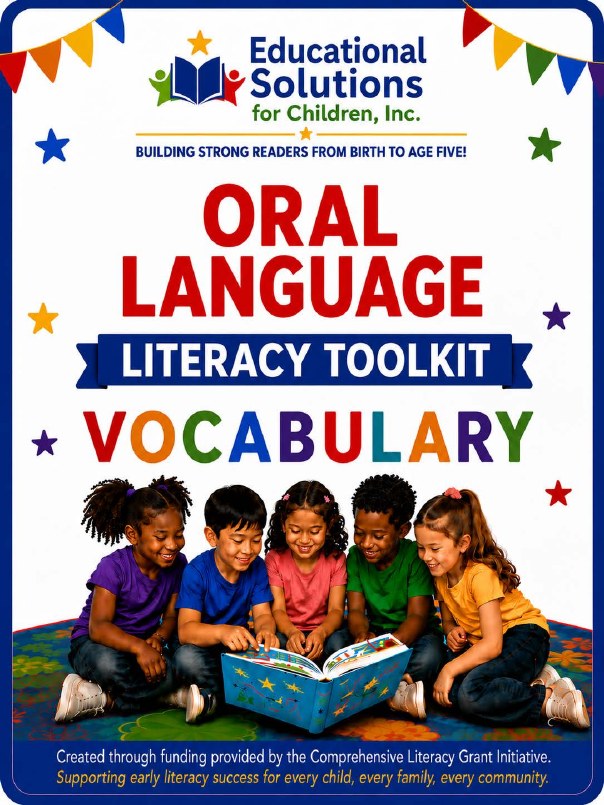
Literacy Toolkit · 54 pages · PDF 7.8 MB
Vocabulary
Supports listening, speaking, understanding and expressing ideas: rich conversations and meaningful opportunities to communicate that build vocabulary, word knowledge and the oral language foundation for later reading and writing.
Tier 2: There words should be highest priority for explicit instruction
Tier 3: These words need a brief definition in context
The video library has short clips of real teachers and parents modelling every one of these skills with preschool and pre-K children.
A free, research-based home for the four practices that build readers before reading begins — written for preschool and pre-K teachers and the families they partner with.